- 리뷰
- 리스트
[eBook] 새로운 패러다임 : 생물학적 세포의 작용 가능성을 형성하는 모델연구
- 글쓴이
- Sucheta SehgalID, Nitish D. PatelID, Avinash Malik, Partha S. RoopID, Mark L. Trew 저
- 출판사
- 아진
- 출판일
- 2020년 7월 10일
읽고있어요
다 읽었어요
읽고싶어요
책 소개
분야생명과학
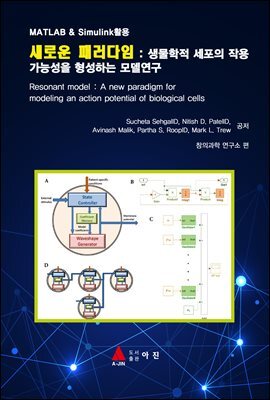
Organ level simulation of bioelectric behavior in the body benefits from flexible
and efficient models of cellular membrane potential. These computational organ
and cell models can be used to study the impact of pharmaceutical drugs, test
hypotheses, assess risk and for closed-loop validation of medical devices. To move
closer to the real-time requirements of this modeling a new flexible Fourier based
general membrane potential model, called as a Resonant model, is developed that
is computationally inexpensive. The new model accurately reproduces non-linear
potential morphologies for a variety of cell types. Specifically, the method is used
to model human and rabbit sinoatrial node, human ventricular myocyte and squid
giant axon electrophysiology. The Resonant models are validated with experimental
data and with other published models. Dynamic changes in biological conditions are
modeled with changing model coefficients and this approach enables ionic channel
alterations to be captured. The Resonant model is used to simulate entrainment
between competing sinoatrial node cells. These models can be easily implemented
in low-cost digital hardware and an alternative, resource-efficient implementations
of sine and cosine functions are presented and it is shown that a Fourier term is
produced with two additions and a binary shift.
전체 리뷰 (0)
최근 작성 순